Showing posts with label Oil. Show all posts
Wednesday, February 24, 2010
Extruders Pt. 2: Add oil
In China, you can encourage someone to work harder by saying "加油!" (jia you), which means "add oil". Apparently that's encouraged our extruder to work harder as well, because adding oil did just the trick. A drop or two of machine oil, applied sparingly to the inner surface of our stainless steel tube on a scrap piece of PLA filament, has got everything finally working smoothly.
I should add that our plastic extruder nozzle tip diameter is unusually large; this is done "just to make sure it works". As the plastic printing is a secondary aspect of our project, we're not too concerned with plastic print resolution and precision for now. On the other hand, an oversized nozzle gives us something like twelve times the print speed, allowing for the printing of bigger objects. Which leads to one of my other observations; perhaps in a multiple-print-head system, a fine nozzle could be used for printing the part perimeter, while a fat one handles the infill. The infiller could even be something as simple as a glue gun running on hot glue, which would actually be quite ideal (cheap, widely available, tough, sticky).
While backflow was undoubtedly an issue in our old extruder, some problems persisted in our new, tight tolerance one. The plug was gone, but extrusion would still fail after cooldown. To see if backflow was causing the problems again, we tried this procedure:
1. Feed fresh PLA
2. Heat up
3. Cool down
4. Heat up
5. Attempt to extrude
As predicted, it was unable to extrude upon reheating. No attempt was made to extrude on the first warm-up this time, so there would be no pressure to cause backflow. If backflow was still occurring it would be due only to the capillary effect. To see if this was causing the problem we removed the filament for postmortem analysis; however, no plug was visible. The diameter was very slightly wider near the tip, where it had warmed up.
We concluded that the softened PLA either had too much friction with the stainless steel surface, or was able form some kind of chemical bond to it, and this was strong enough to prevent extrusion.
Adding a drop of machine oil to the extruder resolved the problem nicely, either by lubrication or by physically preventing the chemical bond. You might ask if this would foul up the extruded PLA, but the oil doesn't appear to get consumed; it apparently stays inside, clinging as a thin film to the steel surface.
In summary: If you find that you can successfully extrude for a little while using a fresh piece of plastic, but it jams the second time, "加油!"
Tuesday, February 23, 2010
Extruders Pt. 1: Backflow and Bench Experiments
Our work on the SpoolHead has been put on hold as we troubleshoot our plastic extruder. What would happen is that the extruder would work great on a fresh piece of PLA, but when we left it to cool and ran it again, it would be unable to extrude (even with Wade's geared extruder providing massive amounts of force). What could explain the extruder working perfectly at the beginning, and grinding to a halt the second time?
We're hoping to fix this as soon as possible, because no doubt there will be much troubleshooting of the SpoolHead as well. To understand the problem, we've been conducting some benchtop tests, observing how the PLA behaves inside the extruder nozzle.
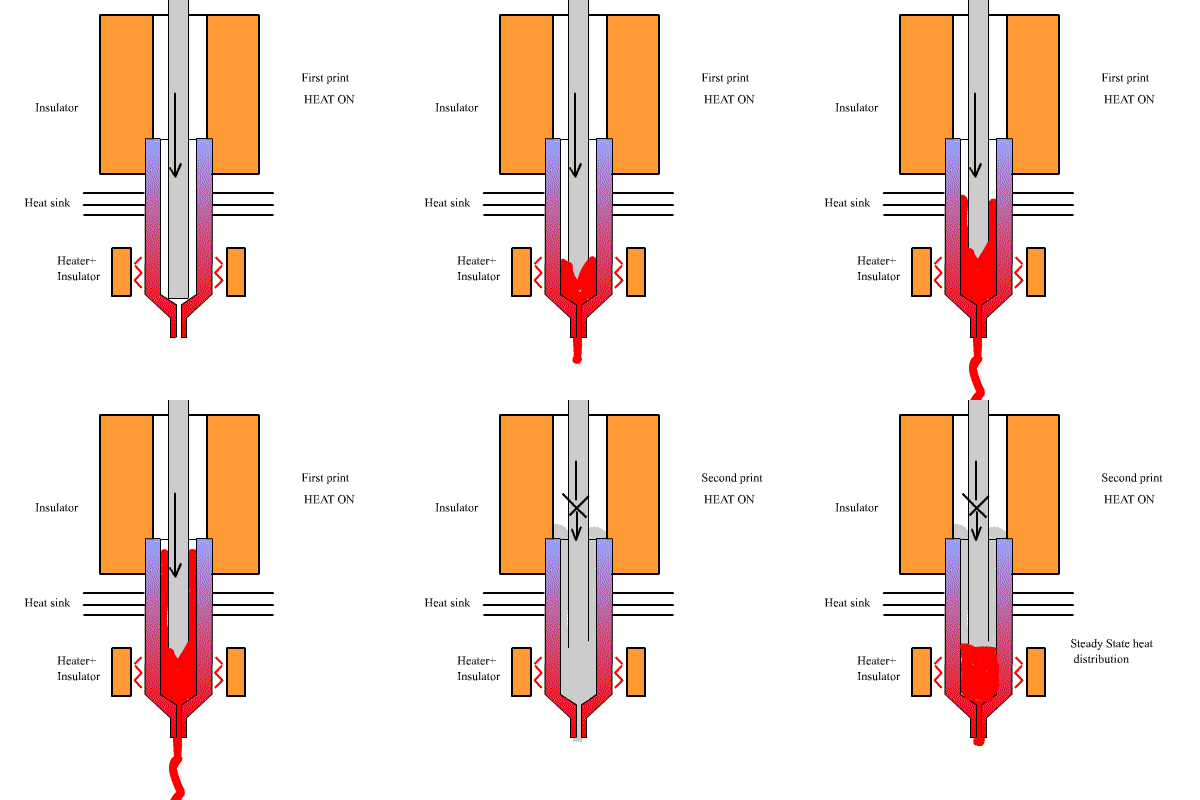
Bing conducted experiments to determine why, after five minutes of successful extrusion, subsequent cooling and re-heating of the extruder caused it to fail. From our experiment, the resistance to flow due to viscosity through a narrow aperture is actually quite small; however, with the current Reprap-standard extruder design, a far more significant problem occurs. Because the nozzle is drilled wide, there is a void between the filament and the metal which fills with molten plastic. Even with a steep temperature drop at the front of the nozzle, and heat sinks, the plastic retains enough of its thermal energy to flow back up the nozzle and cool in problematic places. Indeed, steepening the temperature gradient with heat sinks seems to exacerbate this issue, because it becomes impossible for heat to reach this cooled plastic.
The problem is that the process is not quasistatic; because of the hot plastic's ability to flow rapidly up the nozzle before it can cool to the same temperature as its surroundings, the temperature distribution inside the extruder is not the same on the first run as it is on the second.
Here's how I visualize the process:
What to do about it?
The best solution would probably be Nophead's, which is to have a cone opening outwards, so that pressure on the fluid forces the plastic further outward, rather than back up the nozzle. However, I believe it is also important to maintain as small a void space between the barrel and the filament as possible. That means maintaining tight tolerances, both on the drill diameter of the extruder nozzle, and the filament itself. (Not all PLA filament is created equal.)
Using a PEEK insulator, which bonds relatively well to molten PLA, is probably not the best idea also. Having, if possible, a seal at the transition to the insulator would be of use as well. PTFE's tendency to flow is useful in this regard. We have made a PTFE insulator that is slightly under-drilled right at the end, so that it seals firmly against the plastic. Hopefully this will prevent backflow.
For now, we are also planning to have a wider nozzle at the tip, which will reduce the pressure that causes backflow. This will reduce our part-printing precision, but that's not really a concern for the SpoolHead project, because the plastic extruder merely needs to work.
Subscribe to:
Posts (Atom)